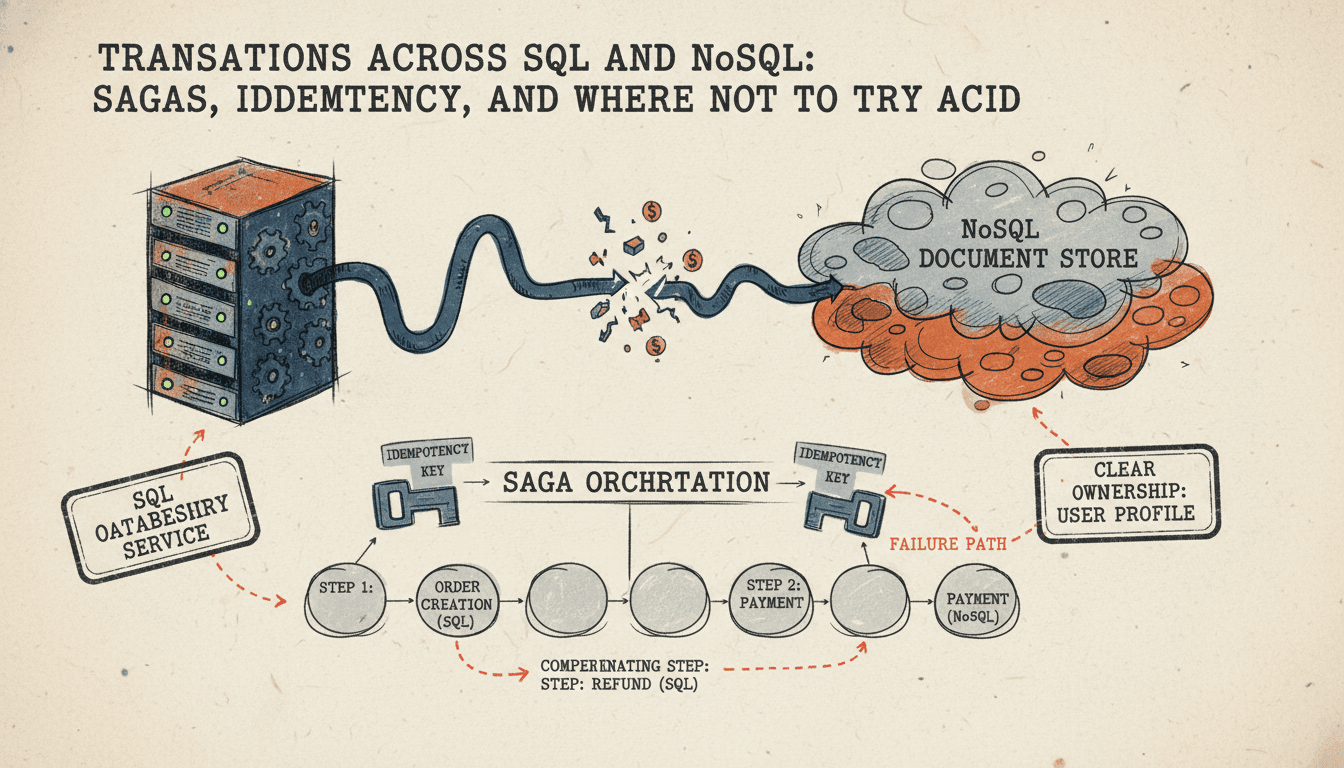
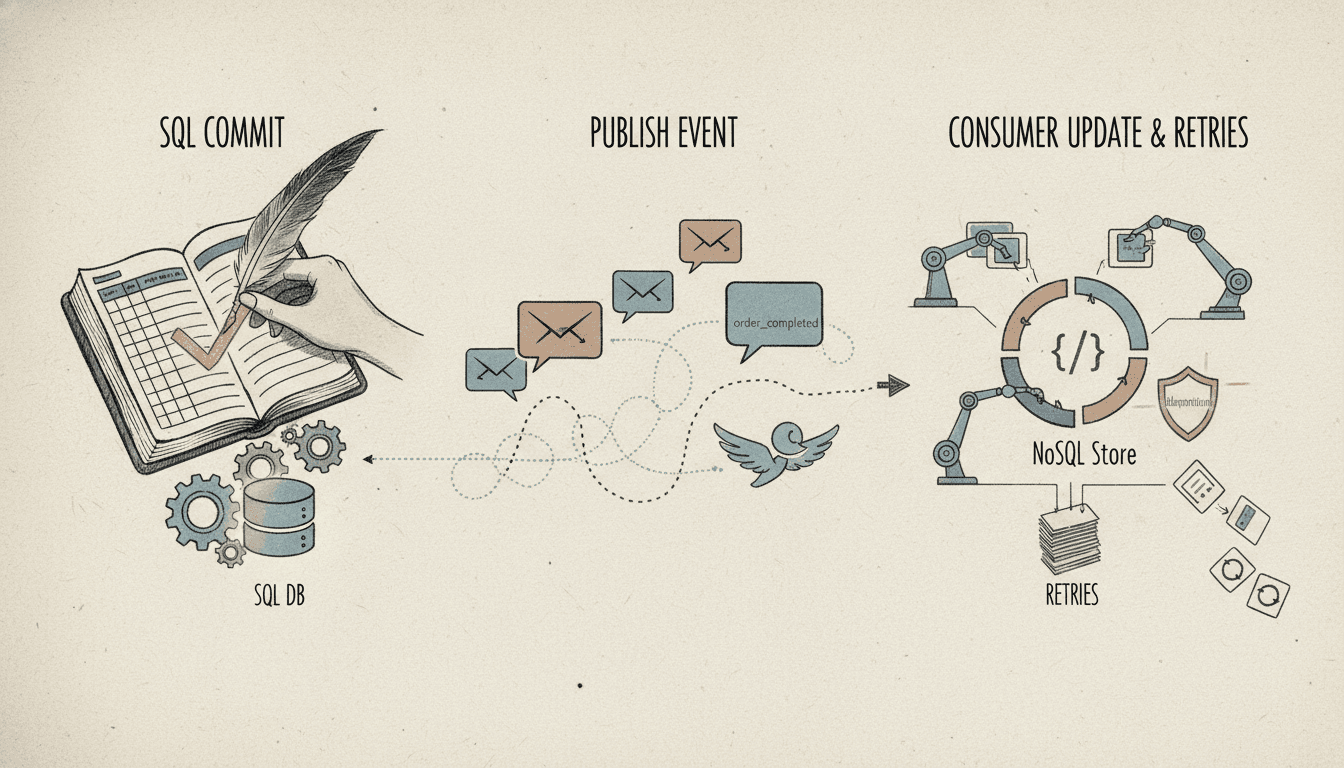
True cross-store ACID is rare and expensive. Most teams use local transactions plus reliable messaging—complete the SQL commit, then publish an event; consumers update the document store and handle retries safely.
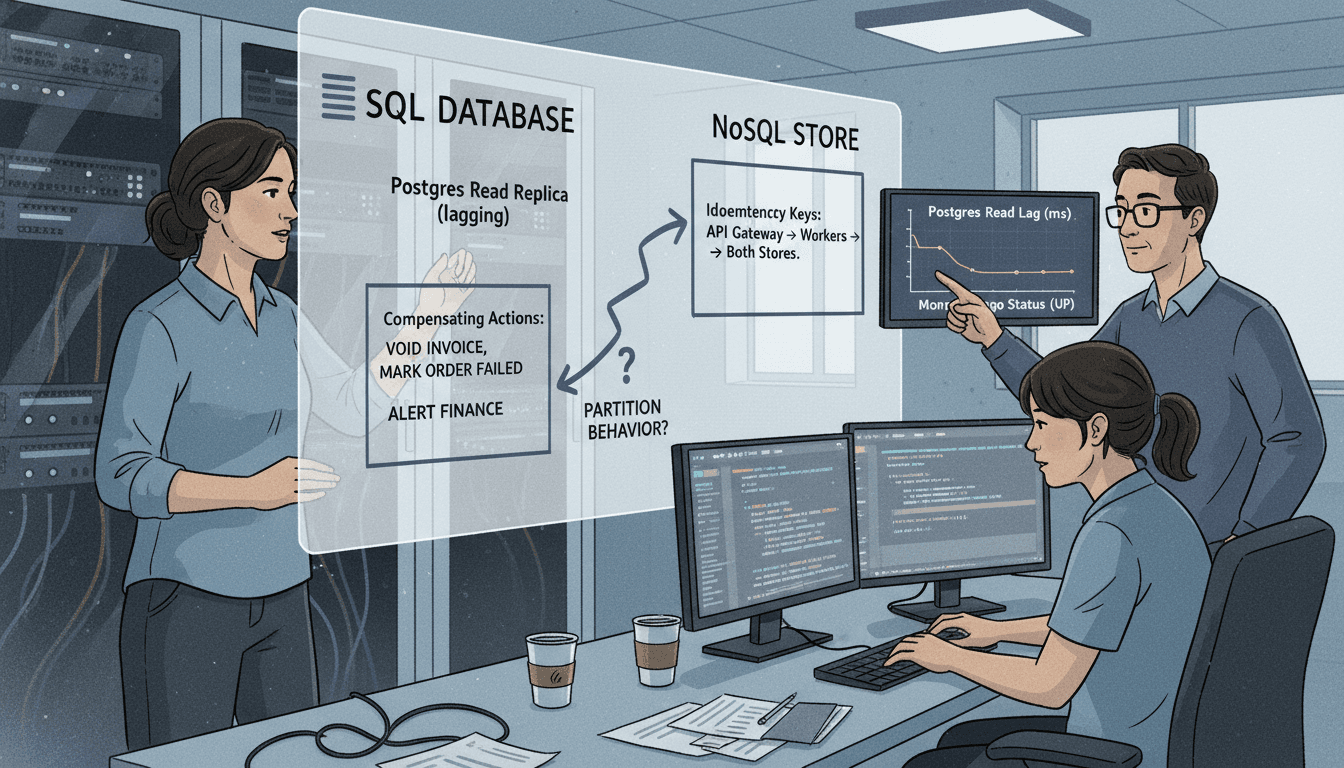
- Pass idempotency keys from API gateways through workers to both stores.
- Model compensating actions: void invoice, mark order failed, alert finance.
- Test partition behavior: what if Mongo is up but Postgres read replica lags?
Redis locks can help short critical sections but are not a distributed transaction engine—keep scope tiny.
How operators translate this into delivery
When initiatives touch transactions across sql and nosql, the bottleneck is rarely syntax—it is clarity on ownership, budgets, and definitions of done. Schedule explicit checkpoints between product marketing, engineering, and security so nobody discovers mismatched assumptions during launch week. Prefer thin slices that prove instrumentation and rollback before you widen scope; that discipline is what Search and internal wikis reward in 2026 when people look for authoritative write-ups tied to sql nosql transactions sagas boundaries.
Finance and compliance teams increasingly ask how work tied to bounded contexts, integration contracts, and data flows that teams can explain to security and finance reviewers maps to ROI. Keep a living one-pager with baseline metrics (conversion paths, incident rate, deployment interval, ticket age) so you can attribute improvements to specific releases—not to vanity dashboards. Capture architecture notes and threat-model fragments where new teammates search first; ambiguity there becomes expensive production risk later.
Alignment questions to answer early
- Who signs off when transactions across sql and nosql affects customer data or SLAs—and on what cadence do they review drift?
- Which environments must mirror production telemetry (including synthetic checks) before executives greenlight rollout?
- What single metric or qualitative signal rolls up to leadership so progress is legible without cherry-picking?
- Where will operators look up the canonical runbook six months from now—wiki, ticketing, or chat—and who keeps it fresh?
Measurement, documentation, and long-term SEO value
Treat this page as living documentation: refresh examples, screenshots, and statistics on a predictable schedule so search engines and coworkers see freshness. Internal search and external search both reward specificity—link to sibling posts in the toolwork.dev blog cluster when concepts overlap (sql nosql transactions sagas boundaries adjacent topics belong in context). When AI-generated summaries appear on SERPs, concise headings and factual bullets increase the odds your narrative survives extraction faithfully.
If your roadmap stacks multiple bets (bounded contexts, integration contracts, and data flows that teams can explain to security and finance reviewers), sequence them so analytics and logs prove each layer before you pile on complexity. Escalate exceptions early—latency regressions, crawl anomalies, OAuth scopes widening—rather than patching silently; institutional memory decays faster than code churn.