
When we build portals or integration hubs, a lot of short-lived state belongs in Redis—not PostgreSQL. Session data, request counters, and outbound API budgets all expire naturally and need fast reads. This is the setup we reach for on most Node.js and Python backends.
Sessions
- Store only an opaque session id in an httpOnly cookie; keep the payload in Redis.
- Use a hash or JSON string with user id, roles, and expiry.
- Set TTL slightly longer than idle timeout so abandoned sessions clean themselves up.
- Alert if evictions spike—users should not get logged out silently because memory filled up.
Rate limiting
- Fixed-window counters work for simple per-IP or per-user limits.
- Use INCR with EXPIRE, or a sliding window with sorted sets for smoother limits.
- Return 429 with Retry-After so clients backoff instead of hammering the API.
- Separate your app’s limits from vendor quotas (Meta and LinkedIn have their own caps).
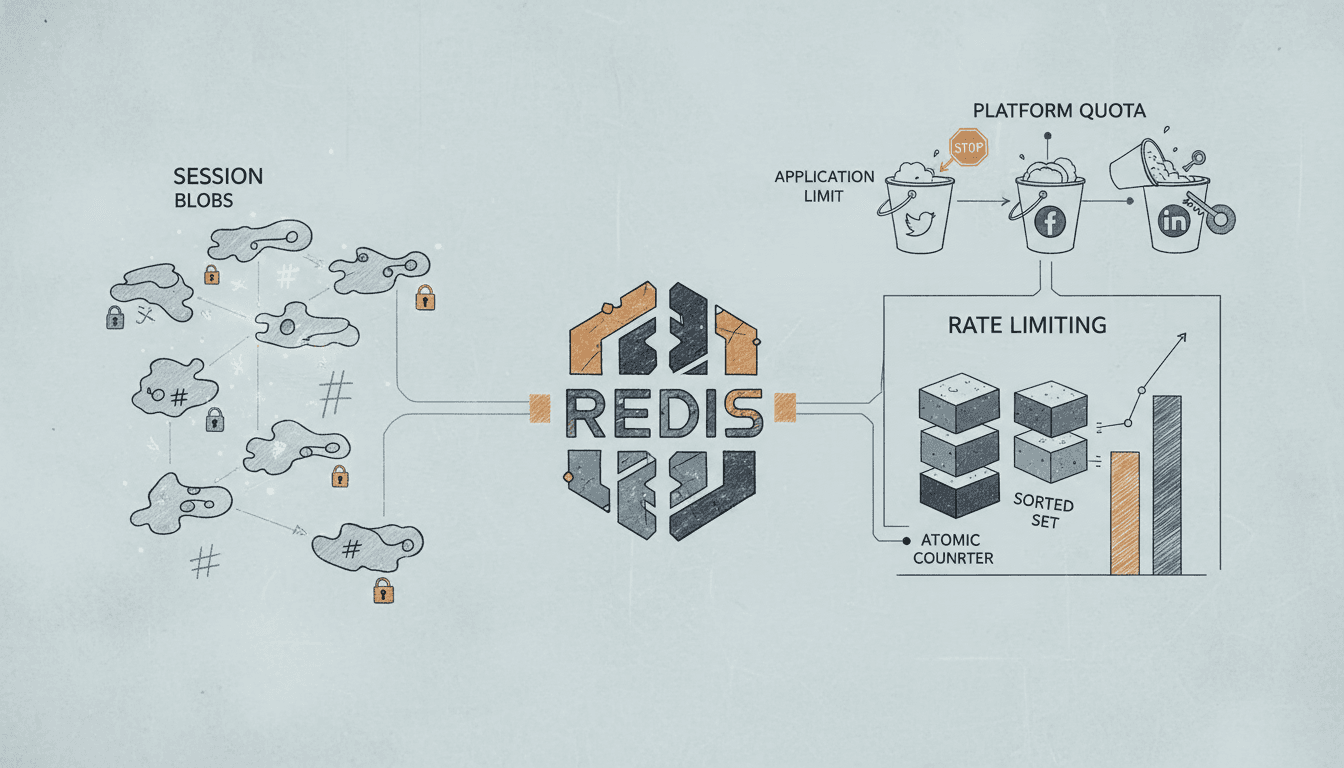
Social API token buckets
For Meta or LinkedIn publishing, we track how many posts or API calls each tenant has left in the current window. Lua scripts help when decrementing credits must be atomic. Dashboards read the same keys so support can see who hit a limit without digging through logs.

How operators translate this into delivery
When initiatives touch redis for sessions, rate limiting, and social api token buckets, the bottleneck is rarely syntax—it is clarity on ownership, budgets, and definitions of done. Schedule explicit checkpoints between product marketing, engineering, and security so nobody discovers mismatched assumptions during launch week. Prefer thin slices that prove instrumentation and rollback before you widen scope; that discipline is what Search and internal wikis reward in 2026 when people look for authoritative write-ups tied to redis sessions rate limiting api tokens.
Finance and compliance teams increasingly ask how work tied to consistent data contracts, operational metrics, and failure modes operators can diagnose at 3 a.m. maps to ROI. Keep a living one-pager with baseline metrics (conversion paths, incident rate, deployment interval, ticket age) so you can attribute improvements to specific releases—not to vanity dashboards. Capture architecture notes and threat-model fragments where new teammates search first; ambiguity there becomes expensive production risk later.
Alignment questions to answer early
- Who signs off when redis for sessions, rate limiting, and social api token buckets affects customer data or SLAs—and on what cadence do they review drift?
- Which environments must mirror production telemetry (including synthetic checks) before executives greenlight rollout?
- What single metric or qualitative signal rolls up to leadership so progress is legible without cherry-picking?
- Where will operators look up the canonical runbook six months from now—wiki, ticketing, or chat—and who keeps it fresh?
Measurement, documentation, and long-term SEO value
Treat this page as living documentation: refresh examples, screenshots, and statistics on a predictable schedule so search engines and coworkers see freshness. Internal search and external search both reward specificity—link to sibling posts in the toolwork.dev blog cluster when concepts overlap (redis sessions rate limiting api tokens adjacent topics belong in context). When AI-generated summaries appear on SERPs, concise headings and factual bullets increase the odds your narrative survives extraction faithfully.
If your roadmap stacks multiple bets (consistent data contracts, operational metrics, and failure modes operators can diagnose at 3 a.m.), sequence them so analytics and logs prove each layer before you pile on complexity. Escalate exceptions early—latency regressions, crawl anomalies, OAuth scopes widening—rather than patching silently; institutional memory decays faster than code churn.